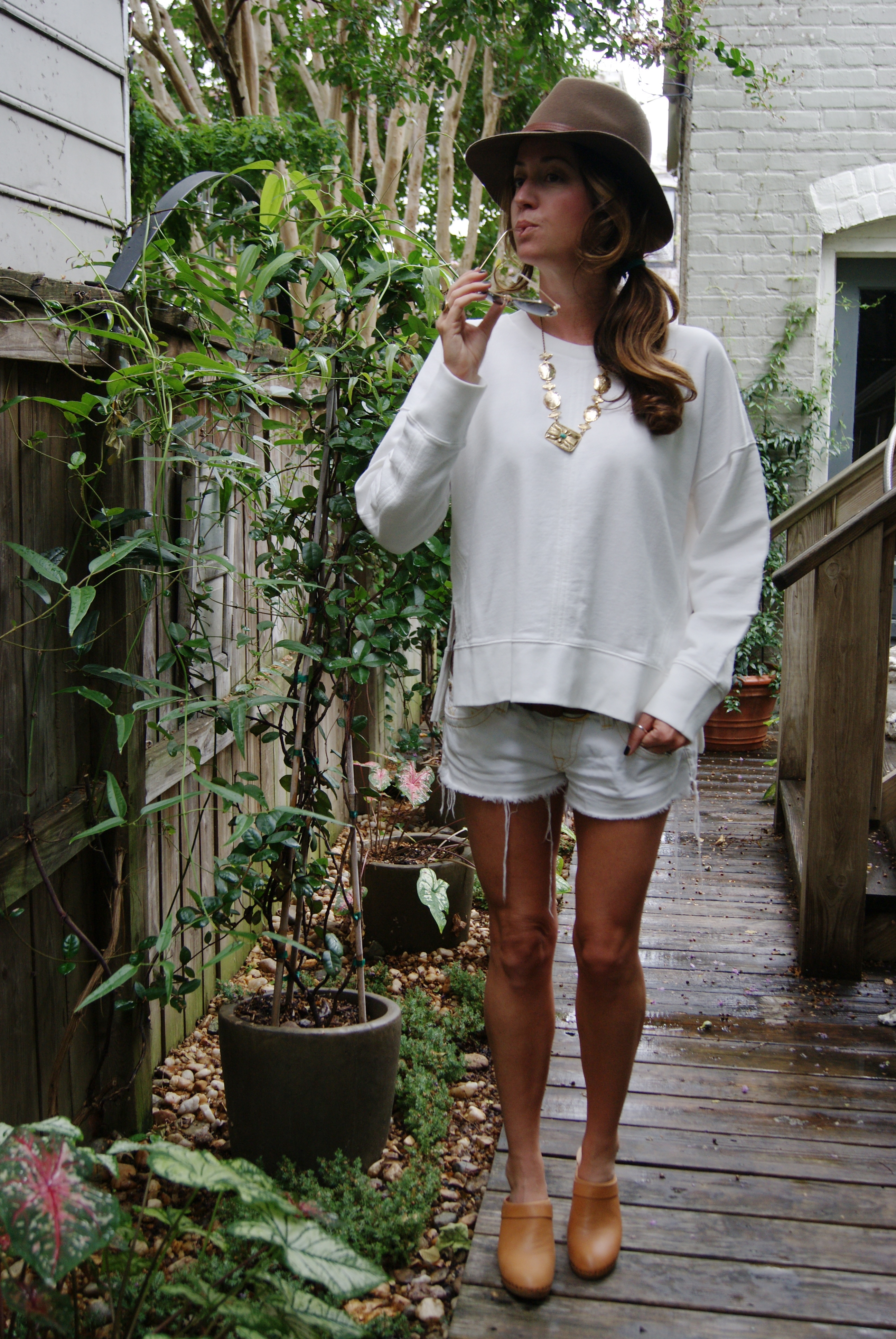
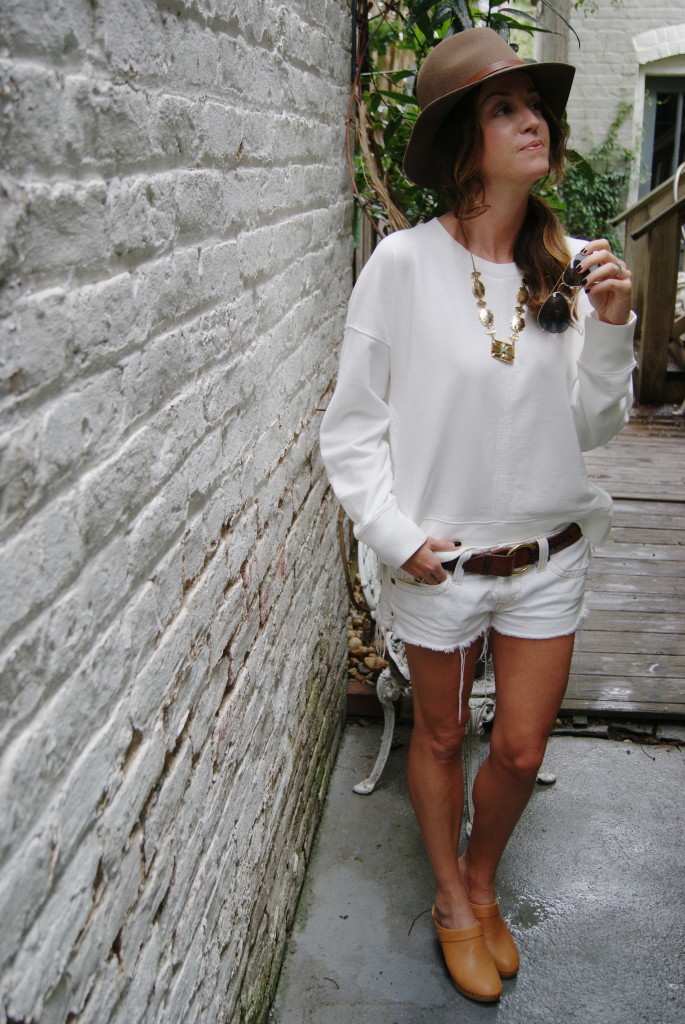
[Isabel Marant clogs + Madewell Forecast sweatshirt + Vanessa Mooney concha necklace + Rag & Bone hat.]
There are these moments my mom called “character-building moments.”
I sat in the empty office. The desk was messy—a cozy, friendly messy, not like the sterile corporate offices I’d grown up around. A nameplate read: “Filmé,” a phonetic play on the desk’s owner’s name. Phil May, Creative Director at Cramer-Krasselt. I put my hands in my lap and took a deep breath.
Framed examples of award-winning work lined the walls. But I could tell the owner of this office did not take himself too seriously. Neither did the Art Director and Copywriter team I’d just met with in a small conference room—a favor on their part, I’m sure. They told me a bit about what they did, where and what they’d studied to get there, advice to join the ranks. I felt lightyears out of my league, nervous as I’d ever been, but they were sincere. They even accepted the Altoids I offered, the tin shaking in my extended hand, the crisp paper rattling crazily. We’d all pretended not to notice.
They dropped me off at Phil’s door. “He’s in a meeting, but just hang out here until he’s done. He’s excited to meet you!” I said my goodbyes and sat in silence for a bit, soaking it up.
This was the office of the only human who, after I’d sent out all those emails, all those resumes, all those shots in the dark, bothered to write me back. He saw something in me. Come see us sometime, he’d suggested.
The only one.
Character-building. Future-deciding.
Outside the window, stories below, downtown Chicago blurred in the glare of Lake Michigan like another planet. I could hear the traffic. I could feel the sunshine. I could taste the cold beer I was going to order. I was almost there. And somewhere on Michigan Avenue, my boyfriend was leaning on a granite column waiting for me with a backpack containing a change of clothes.
Three minutes went by.
Ever noticed how the things we place so much importance on are of such little comfort during character-building moments?
The warmth of the chemicals after adrenaline fades lulled me into a smug, tired, accomplished haze.
Five minutes went by.
I stood up and hovered in the doorway, scanning the halls. I could picture myself here, maybe, I thought. Then I heard someone coming, and like a flash, resumed my seat.
Eight minutes went by.
Ten.
And then, without a word to anyone, I stood up. I picked up my papers, walked past the receptionist, pushed the elevator button, and I left.
I never met Phil, and I never heard from him again.

“But creative people should not fear failure. Creative people should fear the prescribed path to success – its narrowness, its specificity, its reliance on wealth and elite approval. When success is a stranglehold, true freedom is failure. The freedom to fail is the freedom to innovate, to experiment, to challenge.” – Sarah Kendzior
At that phase, all I wanted was a prescribed path. Please, God, someone, give me a prescribed path. And when I got a chance to take the first step, I bailed. I’d had enough character building for the day, apparently. Since then, I’ve had many of those hours, days, and months when you feel like you’ve finished a marathon, and someone says, “Put your shoes back on. Got another one.” Unlike that day, I haven’t bailed.
I knew someone whose sister once had a tapeworm. Story goes, she was throwing up and the little guy started coming out the top end. Seeing an opportunity, they yanked it almost all the way out, but the bit left behind regenerated inside her, living on, shaking its little fist in victory.
That story is my tapeworm barf. Doesn’t matter how many times I get it up, I never feel better.
—
Let’s fast-forward a few years, a few jobs, and lots of incredibly valuable life experience later. I’d abandoned law school dreams after seeing it up close for 1.5 years and determining whatever creative spirit I had left would be vacuumed through my nostrils if I went that route.
I settled on advertising (“advertising writing,” totally unaware of the term copywriting yet) at my dad’s suggestion, and that’s how I’d found myself in the file clerk office adjacent to the mail room, typing away when the attorneys were at lunch, sending emails to every HR portal at every agency in all of Chicago. Cramer-Krasselt’s employment page had a clever prompt: “‘If it ain’t broke, don’t fix it.’ Tell us why we shouldn’t believe that’s true, and maybe we’ll drop you a line.” So I pounced.
To this day I don’t know what I said, but it got their attention, and they indeed dropped me a line. That’s how I ended up staring at Filmé’s name plate.
Who knows where I would have ended up had I stuck around in Phil’s office to meet him. Maybe no further than I did meeting with Mr. Dalton of the Dalton Agency in Jacksonville. Or no further than I did meeting Mr. Rawle of Rawle-Murdy in Charleston, SC. Both were perfectly nice, were generous with their insight, suggested some books to read, or told me to move where the work was. “Clearly,” I thought with a pleasant and positive lilt, “I have to get this done on my own, or not at all.” So I moved.
“Viewing the world creatively is supposed to be an asset, even a virtue. Online job boards burst with ads recruiting “idea people” and “out of the box” thinkers. We are taught that our own creativity will be celebrated as well, and that if we have good ideas, we will succeed.” – Jessica Olien
It took me over 5 years of doing things I didn’t want to do professionally, but doing them well, then another two years writing on top of that, to finally have someone call me a copywriter.
First, I had to break into the agency world.
Losing my agency virginity was, well, interesting. And I thought Lux Lisbon had a rough time.
It started out all hearts and stars. Creativity FOR A LIVING, people. It was palpable: people were funny, work was incredibly high-quality, and you wanted to be there. Forget that I knew nothing about anything and was waiting to be outed as a total hack; I was the most eager, upbeat, positive and happy person I knew. I came in early and smiled at everyone. Working til 2 am was kind of a thrill. I had a habit of saying hello with such gusto that my manager set up a meeting with me to tell me she was concerned that, as I laughed while saying hello in the hall, I was subversively making fun of her. (I laughed again.) If you’re wondering who’s actually writing this, don’t worry: that plucky spirit was not long for this world.
Even the most eager of beavers can be beat into submission by the collective, contagious grump of coworkers. It’s a shame, really. But for me, it was a necessary lesson. (Today, it’s why I never engage in workplace complaining, or do my best to avoid it. I bolt at the first sign of water cooler whining.) Which is why I gave in to the veteran belly-aching. This was my first exposure to creative entitlement, and creative malcontent.
Imagine my surprise to find that the most visibly unhappy people were those whose jobs were the most creative ones: the art directors and copywriters. Not the project managers, or the account services people. The best, I found, were the meanest. As if everything they did could be done with their hands tied behind their backs. Everything they created was in spite of what they were capable of. The real art lay somewhere beyond the gilded cage. Tormented, they were.
My job, however, was the opposite.
I few fat failures on my part led to a rapid upswing in shitty workplace moments. I didn’t even notice I was acquiring a blue ribbon case of anxiety until it was so bad, I was sitting on the paper in a doctor’s office breathing barf aromas, heart hammering out of my chest, unable to eat, 15 lbs below my normal weight, unable to sleep, spontaneously crying, and with two deep grooves worn neatly into my front teeth.
It became pretty clear to me that no matter how creative my industry, I was going to remain an outsider. I was an editor. On good days, I rode the coattails of creative teammates, playing the part of careful, dedicated editor so the team could be brilliant, worry-free. On bad days, I was the garbage in-garbage out person to point a finger at when things went wrong.
Deep down, I knew but was never arrogant enough to say: I’m a copywriter. Not a copyeditor. Someone, please, notice this.
Creative industries are funny places. Creativity, it turns out, can be quantified and packaged. From the outside, this is glamourous. From the inside, it’s hard work. For me, it was a club I could not get into.
I always wanted to prove I was a hard worker. That I’d do things I didn’t want to, and I’d do them well—piled up with character-building. There’s personal and professional immunity in that, right?
Wrong.
Before we press on into part 5, the ain’t broke business? I don’t remember what I said then, but I do know what I’d say now. Those happy creatives, they’re not bitching around the water cooler. They’re up til 2am on weekends pushing their talents on their own accord. The ones who make time for what they love. The ones who keep trying to tinker with their creativity, even when it’s already proven it can pay the bills.
Creativity evolves. It bends; it doesn’t break.
-C.
Read part 3 here.
Hi, I love your outfit! What size of a sweatshirt are you wearing? 🙂